When owners start researching Board & Train programs, most assume all of them look roughly the same: drop your dog off, someone else trains them, you pick up a “fixed” dog a few weeks later. In reality, the format a program is built around, whether that’s a kennel facility or a real home, changes almost everything about what your dog actually experiences and what results you can expect to bring home.
I get asked about this distinction constantly, usually by owners who’ve toured a kennel-style facility and left with a nagging feeling that something wasn’t quite right, even if they couldn’t articulate what. After decades of working with dogs in both traditional and home-based settings, I can tell you that feeling is usually accurate. Here’s what’s actually different, and why it matters more than most marketing materials let on.
What Kennel-Style Board & Train Actually Looks Like
Kennel-style facilities are built around volume and containment. Dogs typically live in individual runs or kennels, are rotated out for structured training sessions with a handler, and spend the rest of their day in that same enclosed space. It’s an efficient model for a facility handling large numbers of dogs at once, and for some dogs, especially those who are highly aroused, unfamiliar with a household, or coming from a shelter environment, that structure and predictability can genuinely help in the short term.
But the model has a built-in limitation: a kennel run is nothing like a living room, a kitchen, a hallway with a doorbell, or a car ride to the vet. A dog can learn a rock-solid “sit” or “down” inside a training yard and still fall apart the first time a stranger rings the doorbell at home, because the skill was never practiced in that context. Dogs are notoriously poor at generalizing behavior across environments unless that generalization is deliberately built into the training plan. If every rep of “wait at the door” happens in a facility corridor, the dog has learned “wait at the door in this specific facility corridor,” not the broader skill an owner actually needs.
What Home-Based Board & Train Looks Like Instead
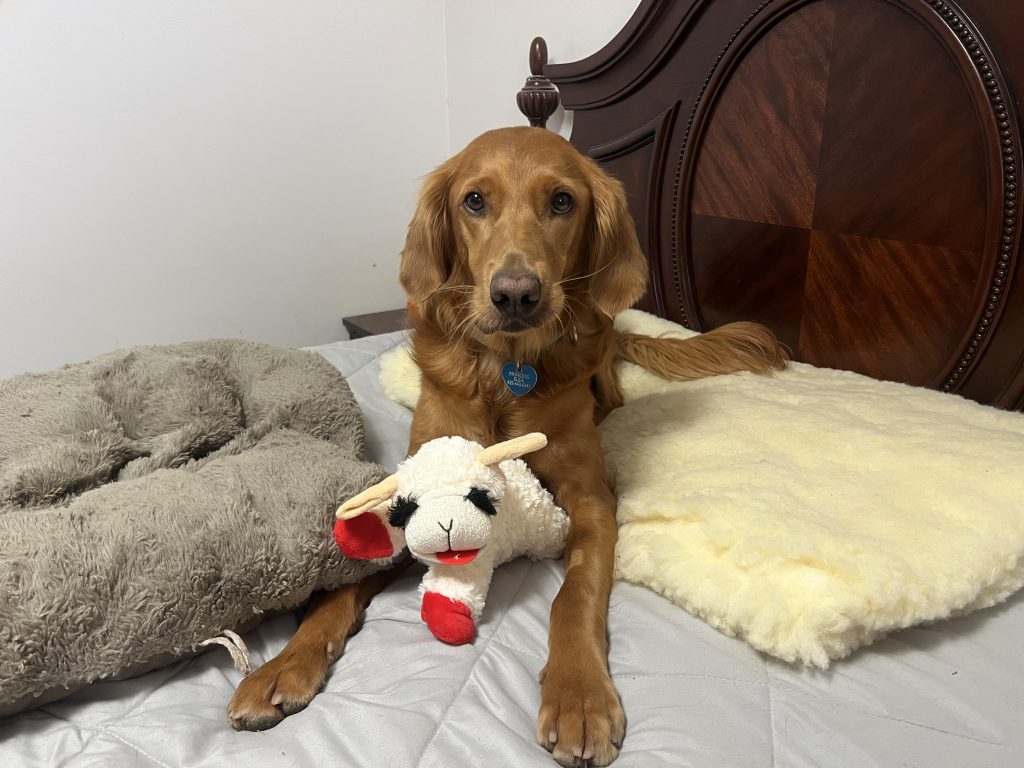
A home-based Board & Train program flips that model. Instead of living in a kennel between sessions, the dog lives inside an actual home, moving through real doorways, real furniture, real daily routines, and real distractions, the entire time they’re there. Training isn’t confined to scheduled sessions; it’s woven into ordinary moments: waiting calmly while a meal is prepared, greeting someone who walks in the front door, settling on a dog bed while the household goes about its evening, walking past distractions on a normal neighborhood street.
This matters because it directly addresses the generalization problem. A dog who has practiced “settle” on a real couch, in a real living room, with a real television playing in the background, is far more likely to be able to do that same behavior in your living room than a dog who only ever practiced it in a sterile training room. The environment isn’t a backdrop, it’s part of the curriculum.
It also allows training to reflect situations that are impossible to recreate in a kennel: entering and exiting the house calmly, adjusting to a household’s actual daily rhythm, responding appropriately to normal domestic noise and activity, and building comfort with the kind of unstructured downtime most dogs spend the majority of their lives in. A dog who’s only ever been trained in high-structure, high-intensity sessions often struggles the moment training ends and ordinary life resumes. A dog trained inside a home has already been living that ordinary life the whole time.
The Emotional Wellbeing Difference
There’s also a wellbeing dimension that’s easy to overlook when comparing programs purely on curriculum. Kennel confinement, even in a clean, well-run facility, is a significant environmental change for most dogs, and prolonged kennel stays can increase stress in dogs who aren’t naturally comfortable in that kind of setting. Elevated stress doesn’t just affect a dog’s emotional state; it directly interferes with learning. A dog in a heightened stress state has a harder time forming new associations, generalizing skills, and retaining what’s been taught, regardless of how skilled the trainer is.
A home environment, with a normal day-to-day rhythm, opportunities to rest on furniture, interact with people throughout the day, and experience actual downtime rather than kennel confinement between sessions, tends to keep a dog in a more regulated state. That regulation isn’t just more humane, it’s more effective. A calmer dog learns faster and retains more, which is part of why the home-based model isn’t just a lifestyle preference, it’s a training advantage.
Why the Transition Home Still Matters, Regardless of Format
Here’s something that applies no matter which format a program uses: training that happened somewhere else still has to transfer to your household, your routines, and your handling. This is the step a lot of programs, kennel or home-based, treat as an afterthought, sending a dog home with a list of cues and leaving the owner to figure out the rest.
A well-designed home-based program treats the transition home as part of the curriculum, not the end of it. That’s why a real Board & Train program should build in structured handoff time, not just a quick debrief at pickup. In our program, that looks like two separate 90-minute sessions with the family after the dog returns home, specifically to coach the owners on the exact skills their dog has learned, troubleshoot the household’s specific challenges, and make sure the training holds up once the dog is back in its normal environment permanently. Training a dog is only half the equation. Training the household to maintain it is the half that actually determines whether the results last.
What This Means If You’re Comparing Programs
If you’re evaluating Board & Train options, a few questions will tell you more than any brochure:
- Where does the dog live during the program, a kennel run or a home environment?
- Does training happen only in scheduled sessions, or throughout the dog’s entire day?
- Is the dog exposed to real household distractions, or only a controlled training space?
- What happens after the dog comes home? Is there structured owner coaching, or just a checklist?
- How does the program handle a dog who doesn’t do well with prolonged kennel confinement?
None of this means kennel-style programs can’t produce results, for the right dog, in the right circumstances, they sometimes do. But if your goal is a dog who can hold a “settle” during a dinner party, greet guests politely, and generalize good manners across the actual environments of daily life, rather than a dog who’s simply well-behaved inside a training facility, the format the program is built around isn’t a minor detail. It’s the difference between training a dog and training a dog for real life.