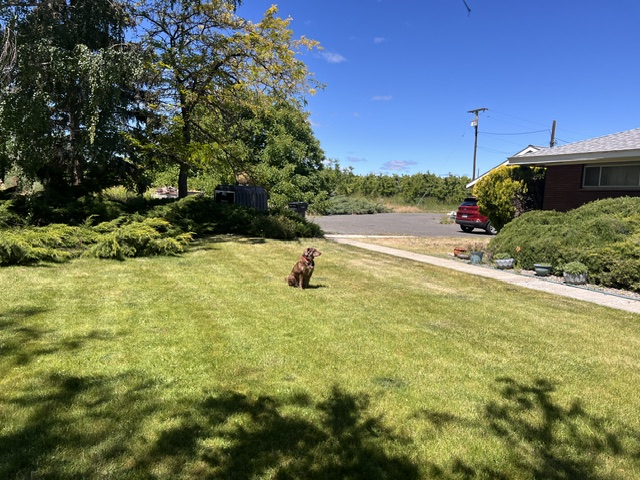
If you’re currently living with a puppy who treats your ankles like a chew toy, has redecorated your baseboards, and still hasn’t figured out that the backyard is where bathroom business happens, take a breath. You are not doing anything wrong, and your puppy is not “bad.” In almost every case, this is exactly what a developing puppy is supposed to look like.
But there’s a real difference between developmentally normal and a pattern that needs intervention before it hardens into something harder to change. After decades working with puppies, including years as a veterinary technician watching thousands of young dogs develop, and continued study under Dr. Ian Dunbar’s training academy, I’ve learned that most of what panics new puppy owners is textbook puppy behavior. The trick is knowing which signs are simply a phase, and which ones are your puppy telling you they need a different kind of support.
Puppy Biting: Almost Always Normal (Here’s Why)
Puppy biting, often called “mouthing,” is not aggression. It’s how puppies explore the world, and it’s also how they learn one of the most important skills a dog will ever develop: bite inhibition, the ability to control the pressure of their jaws.
Here’s what most owners don’t realize: puppies learn bite inhibition primarily from each other, during play with littermates, in the first eight weeks of life. When a puppy bites a sibling too hard, the sibling yelps and stops playing. That feedback loop teaches “hard bites end the fun.” Once a puppy comes home to a human family, that education isn’t finished; it just changes teachers. Now it’s your job to keep giving that same feedback.
What’s normal:
- Mouthing hands, sleeves, hair, or feet during play or excitement
- Biting increasing when a puppy is overtired, overstimulated, or teething
- Biting that intensifies during specific developmental windows, particularly 3–5 months, when adult teeth are coming in
What needs a closer look:
- Biting that’s accompanied by stiff body language, growling with a hard stare, or biting that doesn’t stop with normal redirection
- A puppy who bites harder the more a person reacts, rather than softening
- Biting directed at family members in specific, repeatable contexts, such as only when someone reaches for a collar, a bowl, or a resting space, which can point toward early resource guarding or handling sensitivity rather than simple play
The fix for normal mouthing isn’t punishment: physically correcting a puppy for biting often backfires, either escalating the behavior or teaching the puppy to bite without warning by suppressing the growl or the mouthing that used to come first. Instead, the goal is redirection paired with consistency: give the puppy an appropriate outlet, remove attention the instant teeth touch skin, and manage the environment (exercise, chew items, structured naps) so the puppy isn’t constantly over-threshold. If biting is escalating rather than softening by 5–6 months, or if you’re seeing the context-specific pattern above, that’s the moment to bring in a professional rather than waiting to see if your puppy “grows out of it.”
Chewing: A Puppy’s Job, Not a Character Flaw
Chewing is not your puppy being destructive out of boredom or spite; it’s a developmental necessity. Puppies chew to relieve teething discomfort, to explore textures and objects, and later, as adolescents, to relieve stress and burn mental energy. A puppy who never chews anything is far less common than one who chews everything.
What’s normal:
- Heavy chewing during the teething period (roughly 3–6 months)
- A preference for chewing things that smell like you, such as shoes, remote controls, laundry
- Chewing that increases when a puppy is under-exercised or under-enriched
What needs a closer look:
- Chewing that seems driven by anxiety rather than exploration. For example, destructive chewing that happens specifically when the puppy is left alone, especially if paired with drooling, pacing, or vocalizing, can be an early sign of separation-related distress, which responds far better to early, structured intervention than to being left to resolve on its own.
- A puppy who ingests non-food items compulsively (fabric, rocks, plastic) rather than simply mouthing and dropping them, which carries real medical risk and is worth a conversation with your veterinarian as well as a trainer.
Management matters more than most owners expect here. A tired puppy with the right chew outlets and a puppy-proofed environment will chew appropriately far more often than a puppy who is simply told “no” after the fact. Correction without an appropriate alternative just creates a puppy who’s confused about what is allowed to go in their mouth.
House Training: Slower Than You Think, and That’s Normal
This is the area where I see the most unnecessary stress in new owners, because expectations are almost always miscalibrated. A puppy’s bladder and bowel control is a physical developmental milestone, not just a behavioral one, and most puppies do not have full control until somewhere between 4 and 6 months of age, with some breeds and individuals taking longer.
What’s normal:
- Accidents in the first several weeks home, even with a consistent schedule
- Regression during growth spurts, changes in routine, or a new environment
- A puppy who can “hold it” for a nap but not for excitement: greeting guests, playtime, or right after eating are common accident triggers because arousal genuinely reduces a young puppy’s physical control
What needs a closer look:
- A puppy who is fully accident-free for weeks and then suddenly regresses without a clear change in routine. This is worth ruling out medically first (urinary tract infections and parasites are common, overlooked culprits) before assuming it’s behavioral.
- Marking-type urination that continues well past the typical developmental window, especially in intact puppies approaching adolescence
- A puppy who seems anxious or hides to eliminate, rather than simply having an accident in the open, which can point to a puppy who has been inadvertently punished for house training mistakes and is now afraid to eliminate in front of people at all
That last point matters more than owners realize. Punishing accidents, whether it’s rubbing a nose in it, scolding after the fact, or raised voices, doesn’t teach a puppy where to go. It teaches a puppy that elimination itself is dangerous around humans, which can create a puppy who sneaks off to eliminate in a closet or behind furniture instead of learning the outdoor habit you actually want. The fix is almost always structural: a tighter schedule, closer supervision or containment when you can’t supervise, and heavy reinforcement (treats, praise, genuine enthusiasm) for going in the right spot, every single time, for longer than most owners expect to need it.
The Real Question Isn’t “Is This Normal?” It’s “Is This Improving?”
Almost every behavior above is developmentally appropriate in isolation. What actually separates a phase from a problem is trajectory. A puppy who bites, chews, and has accidents at 10 weeks and is visibly, steadily improving by 16 weeks is right on track. A puppy whose behavior is static or getting more intense as the weeks go by, regardless of which of these three areas it shows up in, is telling you the current approach isn’t giving them what they need to move forward.
That’s not a failure on your part. Puppies don’t come with instructions, and what worked for a dog you had 20 years ago, or what a friend’s puppy needed, may not match what’s happening in your home. The earlier those patterns get identified and addressed with an individualized plan, the easier they are to change, which is exactly why early puppy training exists in the first place, not as a luxury, but as prevention.
If you’re not sure which category your puppy falls into, that uncertainty alone is worth a conversation. A short evaluation can usually tell within one session whether you’re looking at a normal developmental stage that just needs consistency, or an early pattern that will be far easier to shift now than in six months.